How Submarines Work: Diving, Surfacing, Sonar and Surviving the Pressure
A submarine dives by flooding ballast tanks with seawater until it weighs slightly more than the water it displaces, and surfaces by blowing that water back out with compressed air. Once under, it navigates by sound rather than sight, because light dies within a few hundred metres while sound carries for miles. The hull is a cylinder with domed ends because that shape spreads pressure evenly, and every extra 10 metres of depth adds another atmosphere pushing in on it.
A submarine has to solve three problems that a boat never faces: how to sink on purpose without sinking permanently, how to find its way somewhere it cannot see, and how to keep the sea outside while the sea is pushing in from every direction at once.
The answers are more mechanical than most people expect. There is no clever trick, just ballast, air, sound and a very carefully shaped steel tube. Here is how each piece works, followed by the vessels that proved it.
Record-Breaking Deep Sea Submersibles
The handful of craft that have actually reached the deepest parts of the ocean. Fewer people have been to the bottom of the Mariana Trench than have walked on the Moon.
Trieste
Carried two men to the Challenger Deep in 1960, the first crewed descent
Deepsea Challenger
Took a single pilot back to the Challenger Deep alone in 2012
Limiting Factor
The first submersible built to reach full ocean depth repeatedly
Fendouzhe
Chinese crewed submersible that reached roughly 10,900 m in 2020
Kaiko
A robotic craft that surveyed the Challenger Deep before being lost at sea
Nereus
A hybrid robot that could swim free or work on a fibre tether
Shinkai 6500
Japanese research submersible working at 6,500 m for three decades
Bathysphere
A steel ball on a cable that took the first look into the deep in 1930
Research Submersibles and Underwater Robots
Most ocean science is done by these rather than by record attempts. They carry cameras, lights, arms and sample boxes, and they spend their working lives hovering over the seafloor.
Alvin
Found a lost hydrogen bomb, surveyed the Titanic, and still dives today
Jason
A tethered robot piloted from a ship at the surface for hours at a time
Hercules
A remotely operated vehicle built for filming archaeology on the seabed
Mir 1 and Mir 2
A Russian pair that could work together and light each other on camera
Nautile
French submersible that recovered artefacts from the Titanic wreck
Sentry
An untethered mapper that flies a survey pattern on its own
Boaty McBoatface
A genuinely serious polar research robot with a public-vote name
Deep Rover
An acrylic-sphere submersible that gives the pilot near-total visibility
Historic Submarines That Changed the Design
Every submarine today is a refinement of a handful of ideas that these boats proved could work at all.
Turtle
A hand-cranked wooden egg, and the first submarine used in combat, in 1776
Nautilus (1800)
Fulton’s copper-and-iron craft, the first practical submarine design
Hunley
The first submarine to sink a ship, and it did not come home
Holland VI
Combined an engine for the surface with batteries for below, the modern layout
USS Nautilus
The first nuclear submarine, and the first vessel to cross under the North Pole
Typhoon class
The largest submarines ever built, with two pressure hulls side by side
U-boat Type VII
The most-produced submarine in history, built in the hundreds
Yellow Submarine
Not a real boat, but the reason most people can picture one
How a submarine dives and surfaces
Everything comes down to one rule: an object floats if it weighs less than the water it pushes aside, and sinks if it weighs more. A submarine is the only vehicle built to sit on both sides of that line whenever it likes.
Ballast tanks
Between the inner pressure hull and the outer hull sit large tanks that are open to the sea at the bottom and sealed by valves at the top. Open the top valves and air escapes upward while seawater floods in from below, so the boat gets heavier and starts to sink. To surface, compressed air stored in high-pressure flasks is blown into the tanks, forcing the water back out through the bottom openings, and the boat becomes light again.
Trim and hovering
Main ballast is a blunt instrument, so smaller trim tanks move water between the bow and the stern to keep the boat level, and to fine-tune it until it is almost exactly as heavy as the water around it. That state is called neutral buoyancy, and it is what lets a submarine hang motionless at depth instead of constantly rising or falling.
Diving planes
Once it is moving, a submarine steers up and down with small wings called diving planes, exactly the way an aircraft uses elevators. This is faster and more precise than pumping water, which is why a moving submarine changes depth with planes and uses ballast mainly to leave or return to the surface.
Deep-sea submersibles use a simpler version of the same physics. Many drop steel weights to descend, then release more of them to float back up, so a total power failure still ends with the crew rising to the surface.
Surviving the pressure
Water pressure rises by about one atmosphere every 10 metres of depth. At 100 metres the sea is pushing in about eleven times harder than the air does at the beach, and at the bottom of the Mariana Trench it is more than a thousand times harder.
That is why the crew compartment is a cylinder with domed ends rather than a box. A curved surface carries pressure as compression spread evenly through the material, while a flat panel of the same steel would bend inward at the middle. The thick round hull is the reason a submarine looks the way it does.
Windows are the weak point, so there are very few of them. Deep submersible viewports are cone-shaped blocks of acrylic, fitted with the narrow end facing outward, so that pressure pushes them tighter into their seats instead of out of them. The deeper the rating, the thicker the block and the smaller the view.
Air is the other constraint. A nuclear submarine can stay under for months because it makes oxygen by splitting seawater with electricity and scrubs carbon dioxide chemically out of the cabin air. The limit on a modern patrol is food and crew endurance, not the vessel.
Flying a submarine in VR
Submarine VR is our underwater exploration experience for Meta Quest. You pilot a submarine through an open ocean at your own pace, with no combat, no timer and no way to fail, so the whole session is about moving through the water and looking at what is down there.
The part that a diagram cannot teach is the one a headset does teach: depth as a physical sensation. Descending until the surface light is a distant ceiling above you gives you a feel for what those numbers mean that no cross-section drawing manages.
You will meet sea life on the way, including clownfish, dolphins and penguins around the reefs and open water, with educational marine biology content attached. It is rated 4+, so it works as a classroom demonstration after a lesson on buoyancy or sonar as easily as it works as a wind-down.
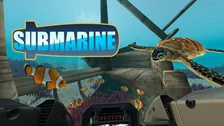
Pilot one yourself in Submarine VR
Dive deep and cruise through the endless uncharted nature of the ocean. Discover clownfish, dolphins, penguins and mysterious sea animals in this immersive underwater VR experience for Meta Quest.
Frequently Asked Questions
How does a submarine sink and float?
+
A submarine sinks by opening valves on its ballast tanks so air escapes and seawater floods in, making it heavier than the water it displaces. To surface, compressed air is blown into those tanks to force the water back out, making the boat lighter than the surrounding water so it rises.
What are ballast tanks?
+
Ballast tanks are large tanks between a submarine’s inner and outer hull that can be filled with seawater or with compressed air. Filling them with water makes the submarine heavier so it dives; filling them with air makes it lighter so it surfaces. Smaller trim tanks fine-tune the balance so the boat can hover at a set depth.
How does sonar work?
+
Active sonar sends a sound pulse into the water and measures how long the echo takes to return, then converts that delay into a distance using the speed of sound in water. Passive sonar sends nothing and simply listens for noise made by other vessels or animals, which reveals their presence without revealing your own.
Why do submarines use sound instead of light or radio?
+
Light is absorbed within a few hundred metres of the surface and radio waves barely travel through seawater at all, so GPS and radar are useless once submerged. Sound travels about four and a half times faster in water than in air and carries for miles, which makes it the only practical way to sense anything at depth.
How deep can a submarine go?
+
Military submarines typically operate a few hundred metres down, with crush depths kept classified. Purpose-built research submersibles go far deeper: Shinkai 6500 works at 6,500 m, and full-ocean-depth craft such as Limiting Factor and Fendouzhe have reached the bottom of the Mariana Trench at roughly 10,900 m.
Why are submarines shaped like tubes?
+
A cylinder with domed ends spreads water pressure evenly through the material as compression, whereas a flat panel of the same thickness would bend inward under the same load. The round pressure hull is the strongest shape for the weight, which is why every deep-diving vessel ends up looking similar.
How do submarines get fresh air?
+
Nuclear submarines generate oxygen by splitting seawater with electricity and remove exhaled carbon dioxide with chemical scrubbers, so the air supply is not the limiting factor. Smaller diesel-electric boats must surface or raise a snorkel to run their engines and refresh the air.
Is there a submarine game for Meta Quest?
+
Yes. Submarine VR is an underwater exploration experience for Meta Quest headsets, available on the Meta Store. You pilot a submarine through an open ocean with no combat, no timer and no fail state, meeting sea life including clownfish, dolphins and penguins along the way.